AI assistant for loyalty management
how business owners create offers in conversation
An AI agent in the dashboard turns a business owner's request into a configured loyalty offer
Aetsoft designed the full protocol, from the consensus mechanism to the smart contract layer.
001
ClientA North American loyalty technology provider
002
ChallengeCustom offers took too much effort to create at scale
003
SolutionAn AI assistant that creates offers through the platform's APIs
Why do complex offers slow business owners down?
Personalised rewards only work when each campaign is translated into precise rules. In the platform, every offer defines who qualifies, what they receive, and when the reward is valid. Change one setting and the campaign behaves differently.
Creating one offer was manageable. The difficulty came when business owners needed to launch many campaigns at once, each with its own segments and reward rules. More complex offers often stalled because owners knew what they wanted to run, but not how to configure it in the system.
What the client needed
The client wanted an assistant built into the business dashboard that could do more than answer questions. It had to:
- Understand a request written in plain language
- Ask for whatever the request leaves out
- Pull data from the requesting owner's loyalty program
- Act through the platform's existing capabilities
- Create offers through a controlled workflow
- Keep every owner's context separate from every other owner's
The client wanted an assistant built into the business dashboard that could do more than answer questions. It had to:

What the client needed
The client wanted an assistant built into the business dashboard that could do more than answer questions. It had to:
- Understand a request written in plain language
- Ask for whatever the request leaves out
- Pull data from the requesting owner's loyalty program
- Act through the platform's existing capabilities
- Create offers through a controlled workflow
- Keep every owner's context separate from every other owner's
The client wanted an assistant built into the business dashboard that could do more than answer questions. It had to:
Solution
What Aetsoft built

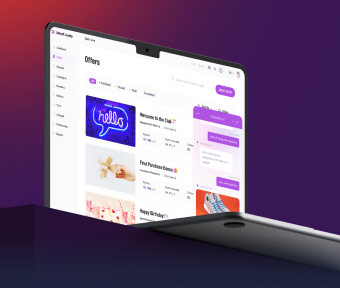
We built the assistant as a conversational widget backed by an AI agent. The widget sits inside the business dashboard. The agent runs behind it and decides what happens next at each step: which question to ask, which API to call.
A business owner can start with a request such as: “Create a New Year offer with double points.”
The assistant first checks whether it has enough information to create a valid offer. When details are missing, it asks follow-up questions or suggests defaults for the owner to approve. It can also retrieve relevant data from the owner's loyalty programme, such as existing offers and points configuration.
Once the required conditions are confirmed, the agent calls the platform’s existing APIs and creates the offer.
The confirmation appears in the same conversation, so the owner can review what was created without leaving the dashboard.
The owner describes the campaign, resolves the missing conditions through a guided conversation, and receives a configured offer. The platform keeps control of the underlying business rules and permissions throughout.
An AI agent is a model plus the tools it may call.
In this project, most of our engineering went into the tools. We implemented and evaluated two architectures
The second was custom: a C#.NET agent on AgentFramework.NET paired with an MCP server. MCP (Model Context Protocol) is an open standard for exposing a system's capabilities to an AI model as callable tools. We generated the MCP server from the platform's existing OpenAPI definition, the quickest part of the project, since a well-documented API is already most of the way to agent-ready.
Authorisation decided the split: Agent Builder doesn't support MCP servers authorised via OAuth 2.0 access tokens, which is exactly what the platform's APIs require. The managed approach was faster to stand up and fine for client-tool use cases. Production runs on the custom C# agent and MCP server, since it preserves the platform's existing OAuth 2.0 model.
One tenant, one context

The platform serves multiple businesses, each with its own loyalty programme, and data. The assistant must operate only within the tenant of the business owner who is signed in.
Every API the agent calls is scoped to that owner's context, so each tool call stays inside their loyalty program. The model itself has no direct access to the platform. Every retrieval and every action runs through authenticated, tenant-scoped tools.
We designed the orchestration layer, the code that sits around the model, to filter sensitive or inappropriate inputs and to keep responses grounded in data retrieved from the platform.

What the assistant
does in production
The delivered
capabilities:

- Creates loyalty offers within the owner's program through conversation
- Answers questions about the owner's existing offers
- Shows the owner their profile details
- Lists the cover images available for a campaign
- Provides points details
- Clarifies campaign rules before anything is created
- Applies approved default parameters
- Confirms the created offer back in the conversation
Results
The client received a production AI assistant embedded in its loyalty management dashboard, running on the custom C# agent and MCP server architecture.
“A business owner can describe a campaign in plain language, settle the missing conditions in conversation, and get a configured offer, without working through each setup field on their own. Each offer now costs less effort and less platform knowledge to create, and that per-offer cost was the barrier the client set out to remove. The platform's rules still decide what a valid offer is.”

- A working flow from user request to loyalty offer creation
- Controlled access to tenant-specific program data
- Authenticated execution through the platform's existing APIs
- An agent architecture that can take on additional loyalty workflows
- An OpenAPI-based route for exposing platform operations as agent tools
Frequently asked questions about AI assistant development
-
What does an AI assistant for loyalty management do?
It lets a business owner manage a loyalty program through conversation. In this implementation, the assistant clarifies campaign parameters, retrieves data from the owner’s own program, and creates offers by calling the platform’s APIs. It performs the same actions the dashboard’s forms perform, through language.
-
How can an AI agent safely access loyalty platform data?
Restrict the agent to APIs that are already scoped to the authenticated user’s context. In this architecture, every tool the agent calls carries the business owner’s authorisation, and the model has no direct access to the platform. Guardrail checks in the agent workflow screen requests and responses around the model.
-
What role does an MCP server play in an AI assistant?
An MCP server describes a system’s capabilities to an AI model as callable tools, using the Model Context Protocol, an open standard. In this project, Aetsoft generated the MCP server from the OpenAPI definition of the platform’s existing APIs, turning documented platform operations into tools the agent could invoke.
-
Can the same architecture be applied to other business systems?
Yes. Any platform with documented APIs and per-user authorisation can support the pattern. Merchant administration, financial product set-up, and SaaS back-office workflows fit it the same way loyalty offers did.
Aetsoft designs and builds production AI agents that work through your existing APIs, from AI development services to full platform integration. Tell us what your users configure by hand today.